You have an idea for an application. Perhaps a tool to simplify your business operations. Perhaps a marketplace to connect your clients with your services. Perhaps a custom CRM you have been searching for months.
And then comes THE question: how much is it going to cost?
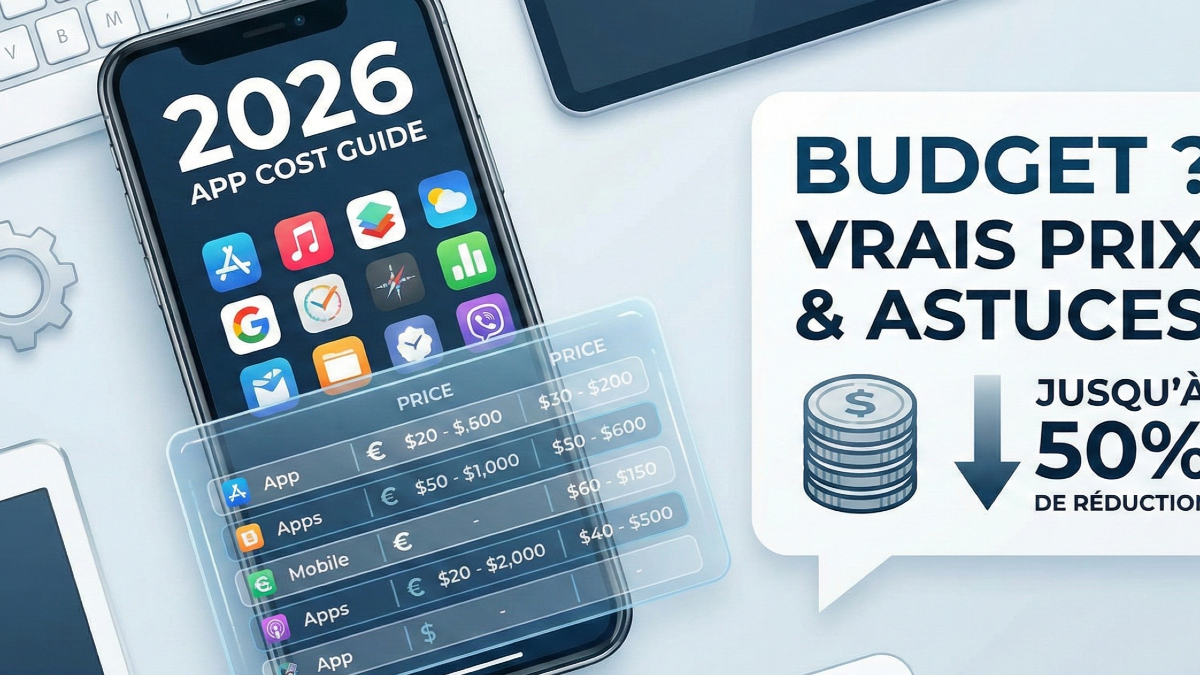
If you have already looked for an answer, you know: it is a complete blur. Estimates range from 5 000 € to 500 000 €, agencies stay vague, and nobody seems willing to give you a clear number.
This guide is different. We are going to give you the real prices, no sugarcoating, with concrete examples.
The factors that determine your application's price
Before talking numbers, let us understand what makes the price vary. This is not a guessing game — each element has a measurable impact.
1. Functional complexity
This is the number one factor. The more your application does, the more it costs.
| Complexity level | Examples | Price range |
|---|---|---|
| Simple | Showcase app, contact form, product catalogue | 5 000 € – 15 000 € |
| Intermediate | App with user login, dashboard, push notifications | 15 000 € – 40 000 € |
| Complex | Marketplace, integrated payments, geolocation, multi-role access | 40 000 € – 80 000 € |
| Highly complex | Social app, integrated AI, real-time features, multi-platform with full back-office | 80 000 € – 200 000 €+ |
2. Target platforms
| Approach | Description | Price impact |
|---|---|---|
| Native iOS only | Swift/Xcode, App Store | Base price |
| Native Android only | Kotlin, Play Store | Base price |
| Cross-platform (Flutter/React Native) | A single codebase for iOS + Android | +20-30% vs a single platform, but -40% vs two native builds |
| Progressive Web App (PWA) | Web application that works like a native app | -30 to -50% vs native |
3. Design and user experience
| Design level | Description | Additional cost |
|---|---|---|
| Template/Standard | Design based on existing components | Included |
| Custom | Bespoke design, dedicated visual identity | +3 000 € to +10 000 € |
| Premium | Animations, micro-interactions, exceptional design | +10 000 € to +25 000 € |
4. Back-end and infrastructure
Your application needs a "brain" to function — that is the back-end.
| Type | Description | Cost |
|---|---|---|
| Backend as a Service (Firebase, Supabase) | Managed infrastructure, quick to set up | 2 000 € – 8 000 € |
| Custom back-end (Laravel, Node.js) | Full control, tailored to specific needs | 5 000 € – 30 000 € |
| Admin back-office | Interface to manage your app's data | 3 000 € – 15 000 € |
Average price by application type in 2026
Here are the ranges we observe on the French market in 2026:
| Application type | Freelancer | Traditional agency | EPREYN (component catalogue) |
|---|---|---|---|
| Simple showcase app | 5 000 – 10 000 € | 8 000 – 15 000 € | Transparent quote |
| E-commerce app | 15 000 – 25 000 € | 25 000 – 50 000 € | Transparent quote |
| Business/management app | 10 000 – 30 000 € | 20 000 – 60 000 € | Transparent quote |
| Marketplace | 25 000 – 50 000 € | 40 000 – 100 000 € | Transparent quote |
| Social app | 30 000 – 60 000 € | 50 000 – 120 000 € | Transparent quote |
Why are the gaps so large? Because the traditional system relies on rough estimates. A developer estimates a feature at 3 hours. In reality, once the need is properly understood, it takes 10. The result: budget overruns, frustrations, and tensions.
Why are traditional quotes so inaccurate?
The fundamental problem is not the price. It is the lack of alignment between you and your developer from the very start.
Here is what typically happens:
- You explain your idea (often in 30 minutes)
- The developer estimates a fixed price (based on their understanding — often partial)
- Development begins and grey areas emerge
- Adjustments pile up — the price climbs
- The result does not match what you had in mind
This system penalises everyone. Cooperative clients often pay too much, while demanding clients "squeeze" unplanned features at the expense of quality.
A different approach: component-based pricing
Imagine a system where every element of your application has a fixed price, like an a la carte menu at a restaurant.
That is exactly what the component catalogue approach offers:
- A login screen — fixed price
- A dashboard — fixed price
- A notification system — fixed price
- A payment module — fixed price
Your application = the sum of the components you choose. Nothing more, nothing less.
The benefits for you
- You know exactly how much it costs before you start
- You build your app a la carte — you only pay for what you want
- You see your app as a mockup before making any financial commitment
- You adjust the scope according to your budget — the quote adjusts automatically
How to reduce your application's cost
1. Start with an MVP (Minimum Viable Product)
Do not build everything at once. Identify the 3-5 essential features, launch a first version, then enrich it based on user feedback.
2. Choose cross-platform development
With technologies like Flutter, you develop once for both iOS AND Android. Estimated savings: 30 to 40% compared to dual native development.
3. Opt for instalment payments
A 10 000 € project paid in 5 monthly instalments of 2 000 € becomes much more accessible. Ask your provider if they offer this option.
Hidden costs you should not forget
Beyond initial development, plan for:
| Item | Estimated annual cost |
|---|---|
| Hosting / servers | 200 € – 2 000 € |
| Bug fixes and corrective maintenance | 1 000 € – 5 000 € |
| Updates (OS, security) | 500 € – 3 000 € |
| App store publishing (Apple + Google) | 125 € |
| Feature enhancements | Variable |
Golden rule: plan for approximately 15-20% of the initial cost per year for maintenance and enhancements.
How to get a reliable quote?
- List your features — even roughly
- Define your priorities — which features are essential vs nice-to-have?
- Identify your users — who will use the app and how?
- Set your budget — even a range helps frame the project
- Request a mockup — it is the best way to visualise the result before committing
Your next step
You now have a clear picture of the real costs of app development in 2026. The question is no longer "how much does it cost?" but "how do I get the best possible app for my budget?".
At EPREYN, we show you your application as a mockup before any financial commitment. Every component has a fixed price. Zero surprises, zero hidden fees.