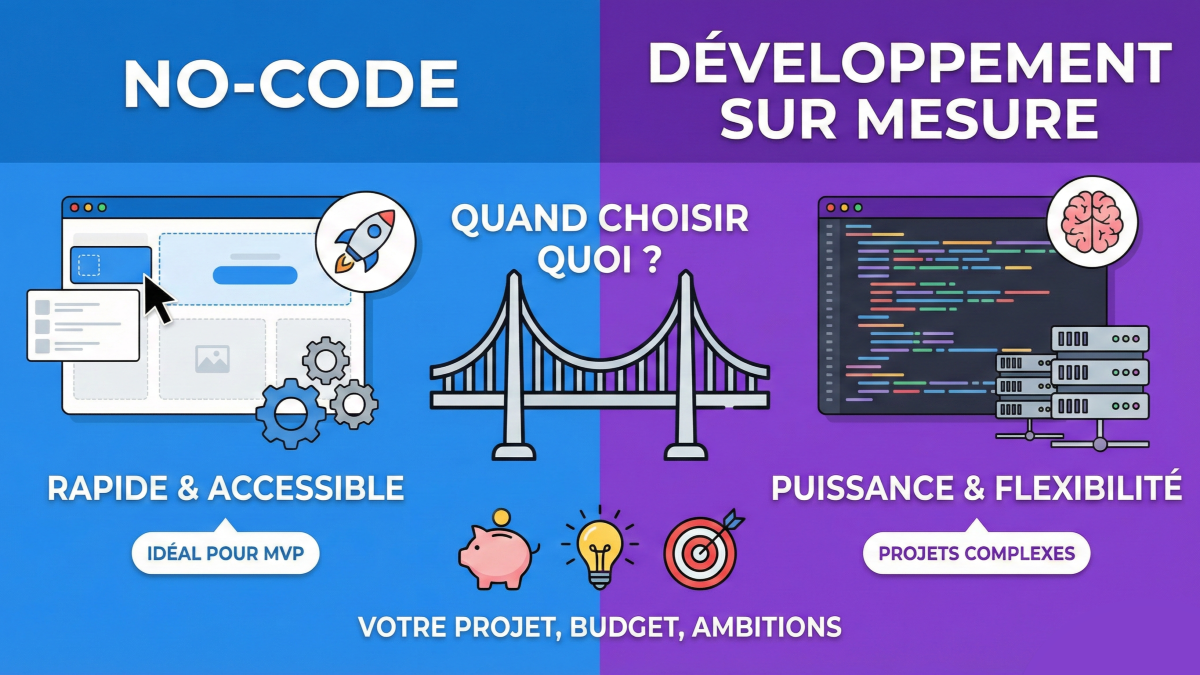
You want to create an application for your business. While searching for solutions, you stumble upon two worlds that seem to clash: on one side, no-code platforms (Bubble, Adalo, FlutterFlow); on the other, custom development with professional developers.
No-code advocates promise you an app in a few weeks for a few hundred euros. Developers talk about months of work and five-figure budgets.
Who should you believe? The answer, as often, depends on your situation.
What exactly is no-code?
No-code refers to platforms that allow you to create applications without writing code, by assembling visual blocks. It is like building with LEGO: you pick predefined pieces and snap them together.
Popular no-code platforms in 2026
| Platform | Specialty | Monthly price |
|---|---|---|
| Bubble | Web applications | 29 – 349 €/month |
| Adalo | Simple mobile apps | 36 – 200 €/month |
| FlutterFlow | Visual Flutter apps | 30 – 70 €/month |
| Glide | Apps built from Google Sheets | 25 – 249 €/month |
| Softr | Apps built from Airtable | 49 – 269 €/month |
The real advantages of no-code
1. Speed to market
A working prototype in a few days to a few weeks, compared to several months for custom development. For testing an idea quickly, it is unbeatable.
2. Low initial cost
No developer to pay. You invest your time and a monthly subscription. Starting budget: 500 to 5 000 € instead of 10 000 to 50 000 €.
3. Accessibility
You do not need technical skills. If you can use PowerPoint, you can build a no-code app.
4. Rapid iteration
Modifying a screen, adding a field, changing a workflow: a few clicks are all it takes. No need to wait for a developer.
The real limitations of no-code (that nobody tells you about)
1. The functional glass ceiling
Every no-code platform has technical limits. When your needs exceed what predefined blocks can do, you are stuck. And that moment arrives sooner than you think.
Examples of features that are difficult or impossible with no-code:
- Complex business algorithms (calculations specific to your industry)
- Integrations with proprietary systems
- Handling large data volumes (> 10 000 records)
- Advanced real-time features (chat, custom push notifications)
- Enhanced security (advanced GDPR compliance, encryption)
2. Platform dependency (vendor lock-in)
Your app is trapped within the platform. If Bubble increases its prices by 300%, changes its terms, or shuts down, you lose everything. You do not own the source code. You cannot migrate easily.
3. Performance
No-code applications are generally slower than native applications. For an internal tool with 5 users, that is fine. For a consumer-facing app with thousands of users, it is a problem.
4. Long-term cost
| Period | No-code (Bubble Pro) | Custom development |
|---|---|---|
| Year 1 | ~4 200 €/year (subscription) | 10 000 – 20 000 € (development) |
| Year 2 | ~4 200 €/year | ~2 000 €/year (maintenance) |
| Year 3 | ~4 200 €/year | ~2 000 €/year |
| 3-year total | ~12 600 € | ~14 000 – 24 000 € |
| Year 5 | ~21 000 € cumulative | ~18 000 – 28 000 € cumulative |
Surprise: over 3 to 5 years, no-code can cost just as much as custom development, without the advantage of owning your code.
5. Scalability
Your business grows, but your no-code app cannot keep up. The day you need to switch to custom development, you start from scratch. Your no-code investment is lost.
When should you choose no-code?
No-code is the right choice if:
- You are testing an idea and need a rapid prototype
- Your needs are simple: forms, basic dashboards, CRUD operations
- You have a limited budget and plenty of personal time to invest
- Your user count will remain small (< 100 active users)
- You do not need complex integrations
When should you choose custom development?
Custom development is the right choice if:
- Your application is core to your business (not a gadget, a strategic tool)
- You have specific needs that templates cannot cover
- You are planning for growth (users, features, data)
- Security is critical (sensitive data, regulatory compliance)
- You want full control over your tool — own the code, choose hosting, evolve freely
- Your app needs to be performant for a great user experience
The best of both worlds: the mockup approach
What if you could have the visualisation speed of no-code with the quality of custom development?
That is exactly what the mockup approach offers: before any development begins, you see your complete application as an interactive mockup. You validate every screen, every interaction, every flow. The result matches exactly what you expect.
Then, custom development delivers an application that is:
- Performant — fast response times
- Scalable — new features without limits
- Secure — you control your data
- Independent — no third-party dependency
In summary: the comparison table
| Criterion | No-code | Custom development |
|---|---|---|
| Initial cost | Low | Medium to high |
| 3-year cost | Medium | Similar or lower |
| Speed | Very fast | 2-6 months |
| Performance | Limited | Excellent |
| Customisation | Limited | Unlimited |
| Scalability | Limited | Unlimited |
| Code ownership | No | Yes |
| Platform dependency | High | None |
| Security | Standard | Custom |
Your next step
Still undecided? Ask yourself this question: is your application a temporary project or a long-term investment?
If it is an investment, custom development will give you more value over time. And with a transparent component-based pricing system, you know exactly what you are paying for.
Book an appointment to see your app as a mockup before you decide →